BitTag
BitTag is the smallest tag in the family and the one the whole architecture is named for. It answers a single question — when was the bird active? — and spends almost nothing doing it. The board documented here is BitTagv7.
The board
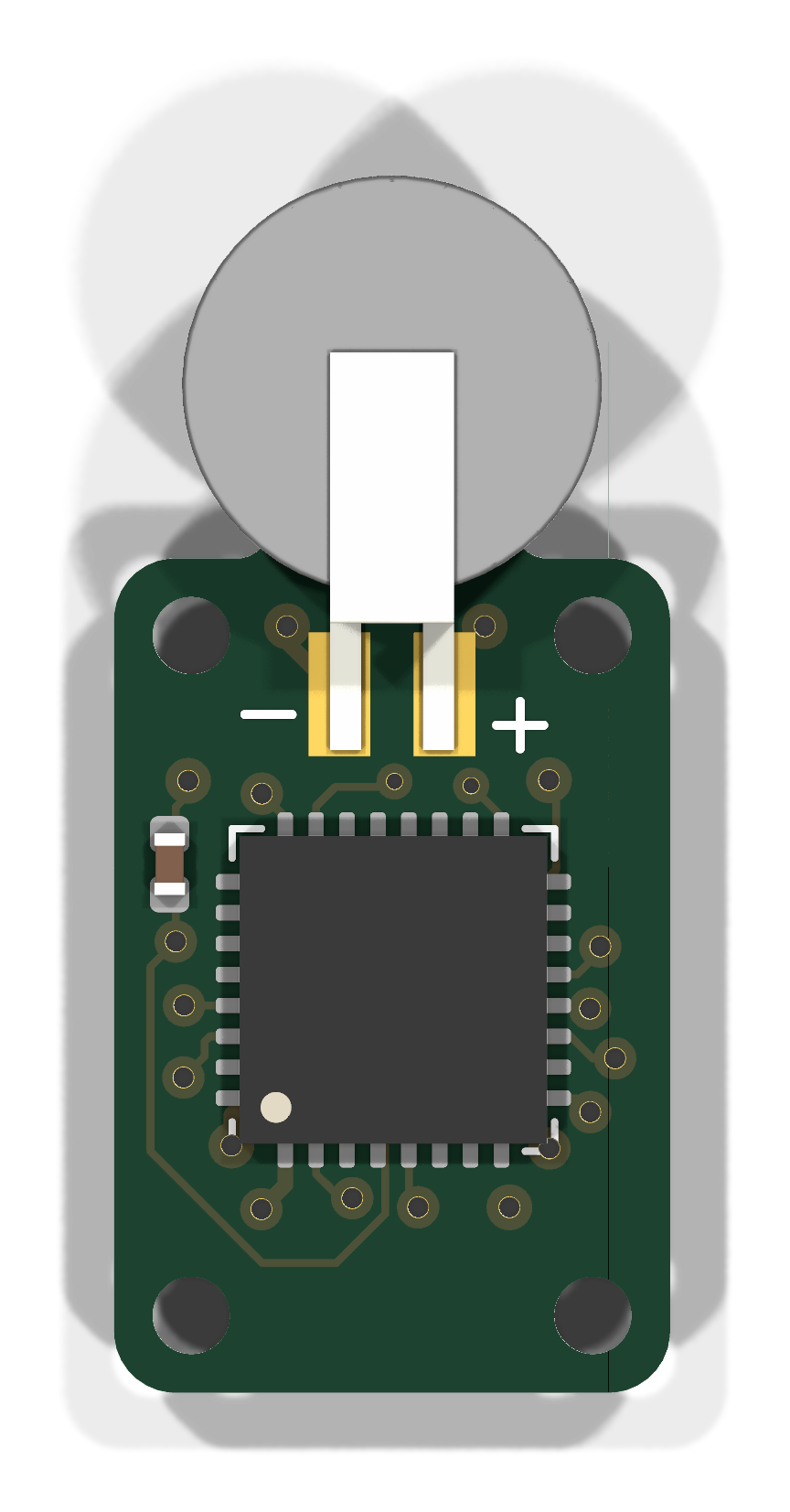
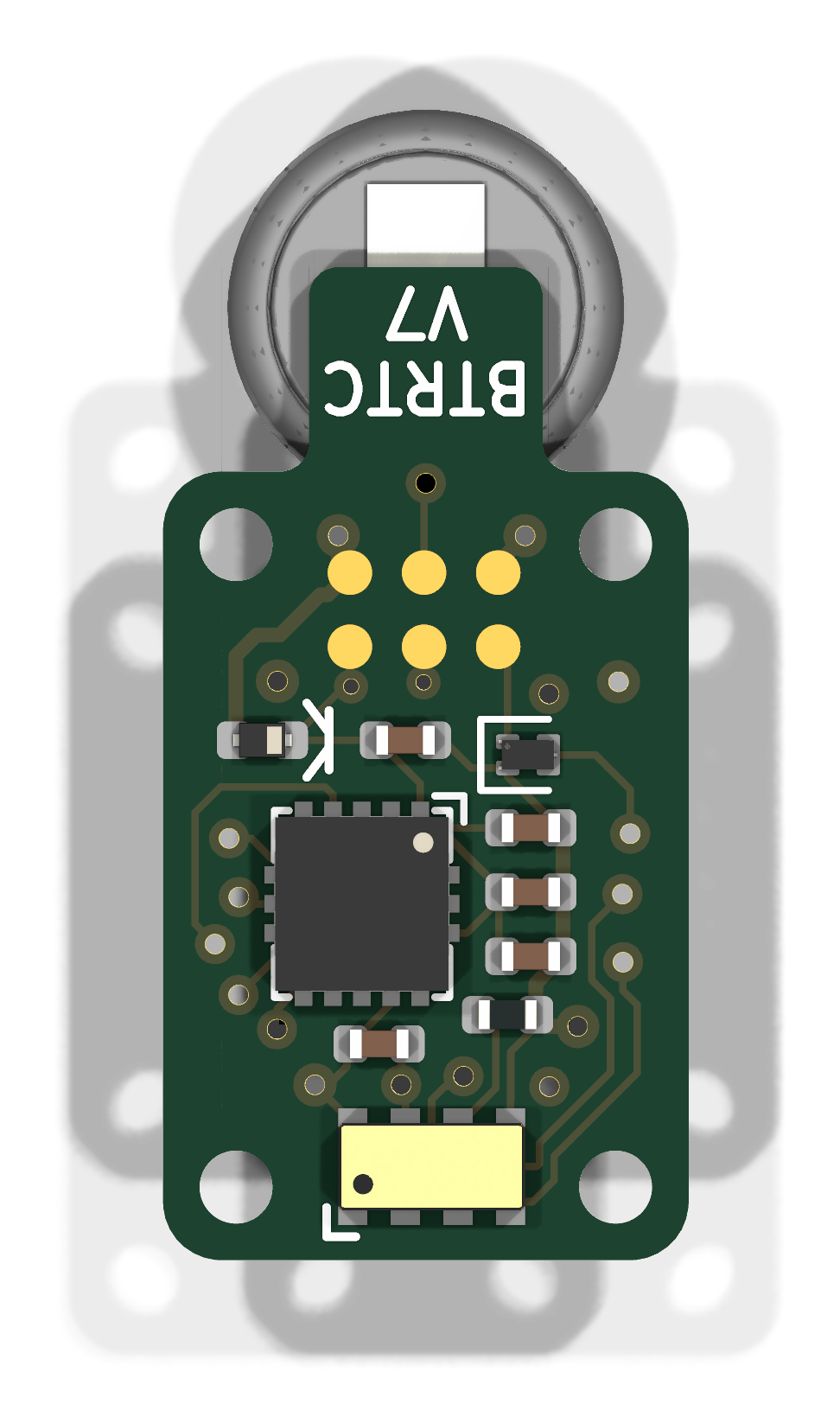
The processor is on the top side; the accelerometer, RTC, Schottky and the six gold pogo pads are on the bottom. These are rendered from the KiCad layout by kicad-cli; see
Board Designs for how they are regenerated.
Block diagram
flowchart LR
  subgraph TAG[BitTagv7]
    direction LR
    subgraph ON[Always on]
      direction TB
      RTC["RV-3028-C7<br/>RTC"]
      MCU["STM32L432KCU6<br/>processor"]
      ACC["ADXL362<br/>accelerometer"]
      RTC --- MCU
      MCU --- ACC
    end
    subgraph PWR[Power]
      BAT["MS621FE-FL11E or<br/>MS920SE-FL27E<br/>D401 Schottky"]
    end
    IF["Interface<br/>SWD + pogo pads"]
  end
  ON --- PWR
  ON --- IF
There is no switched section. Every part on this board is low enough in quiescent current to stay powered for the life of the deployment, so nothing needs a load switch.
Major components
| Role | Part | Notes |
|---|---|---|
| Processor | STM32L432KCU6 | Cortex-M4; the deep sleep states are what make the energy budget work |
| RTC | RV-3028-C7 | 32.768 kHz, 1 ppm, ~40 nA |
| Sensor | ADXL362BCCZ | 3-axis accelerometer with a hardware activity/inactivity state machine |
| Memory | (internal only) | No external flash — records go to the processor's own flash |
| Power | D401 CDBQC0130L-HF | Schottky reverse-polarity protection; no regulator |
| Battery | MS621FE-FL11E or MS920SE-FL27E | 5.5 mAh / 230 mg, or 11 mAh / 450 mg |
Memory is the thing to notice. BitTagv7 carries no external flash chip at all: 18 placed footprints, and none of them is a memory part. Activity records live in the STM32L432's internal flash. That is what keeps the board small and the standby current low, and it is also what bounds how much a BitTag can record before it must be recovered.
There is no regulator either. Parts run directly at battery voltage less one Schottky drop. With a 3 V coin cell that lands near 2.8 V, comfortably inside the 1.71–3.6 V window the STM32 and the ADXL362 share.
The cell chemistry is not a free choice
This board takes one of two Seiko rechargeable coin cells: the MS621FE-FL11E (5.5 mAh, 230 mg) or the MS920SE-FL27E (11 mAh, 450 mg). Which one is a mass-versus-endurance decision for the deployment.
Neither may be swapped for a 3.7 V LiPo. Without a regulator the rail follows the cell, and a LiPo charged to 4.2 V would put roughly 4.0 V on it — the absolute maximum rating of both the processor and the accelerometer, not merely outside their operating range.
What it records
The ADXL362 does the sensing without waking the processor. When an active accelerometer sees acceleration below a programmed threshold for a programmed period it drops into an inactive state and samples at 6 Hz; when an inactive accelerometer sees acceleration above threshold it wakes and samples faster. The firmware wakes the processor only on the transitions between those two states, and from them reconstructs when the bird was active.
The result is one activity bit per second, aggregated over an interval between one second and five minutes. That is a coarse record by design: it is what allows a BitTag to run for most of a year on a 5.5 mAh cell.
Power
Measured on firmware fw-v0.6 at 2.4961 V from an unregulated 2.5 V
cell, on this board.
The measurement logs record it as "BitTag V6": BOARD_NAME in the firmware's
custom.h is stale and the board is a v7. Worth knowing if you read the
software-side logs, and nothing more than that.
| State | Current |
|---|---|
IDLE |
0.12 µA |
RUNNING, 1 bit / 5 min (default) |
0.49 µA |
RUNNING, 1 bit / s |
0.51 µA |
FINISHED |
0.12 µA |
On the cell alone, that is roughly 460 days recording on a 5.5 mAh MS621FE-FL11E and 930 days on an 11 mAh MS920SE-FL27E.
The logging rate is nearly free. Writing 300 times less often buys about 2.6%: the run current is set by the ADXL362 watching for activity, not by how often a bit is stored. Do not estimate battery life from the record rate.
Full log: BitTag power results.
Design files
Design directory on GitHub Schematic (PDF)
No design review has been written for this board.