steval-daughter-v2
A generic carrier. Where the other prototype boards commit to a fixed sensor set, this one carries a socket for ST's own evaluation boards, so any sensor ST ships on a STEVAL card can be driven by the project's firmware and measured on the project's bench.
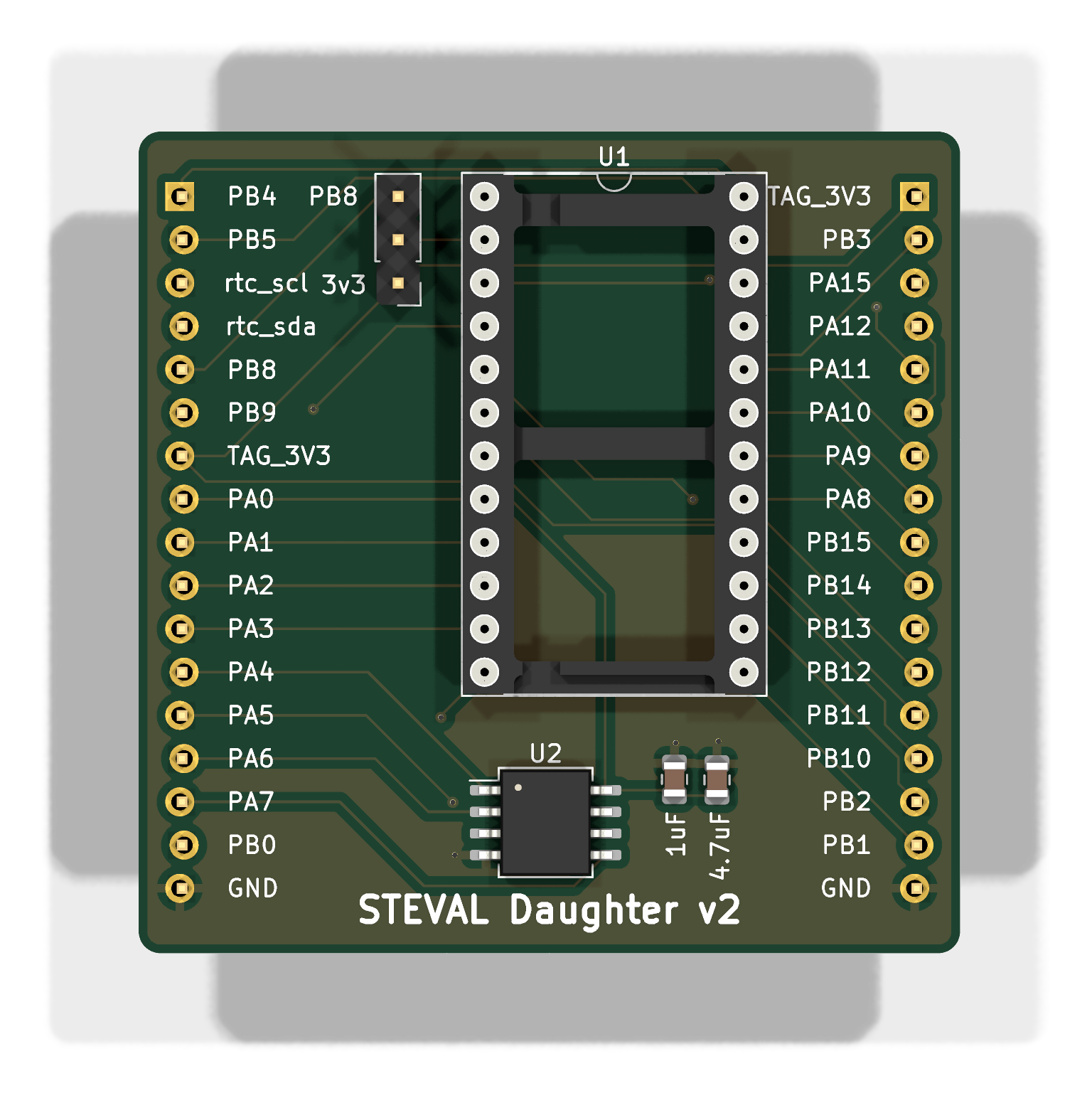
Block diagram
flowchart TB
  subgraph PROTO["steval-daughter-v2"]
    direction LR
    SOCK["Socket for an<br/>ST STEVAL card"]
    MEM["AT25FF321<br/>serial flash"]
    CONN["J3 + J4<br/>2 × 1×17 header"]
  end
  SOCK --- CONN
  MEM --- CONN
  CONN === BASE["Breakout base<br/>processor, RTC, regulator"]
Major components
| Role | Part | Notes |
|---|---|---|
| Evaluation socket | ST STEVAL card socket | Whatever sensor the card carries |
| Memory | AT25FF321 | Serial flash, because most STEVAL cards have none |
| Base interface | J3, J4 — Conn_01x17 |
What it is for
Evaluating a sensor before committing a board to it. ST publishes STEVAL evaluation cards for most of its sensor range. Socketing one here puts it behind the same processor, the same firmware and the same measurement setup as a real tag, so the question "what would this part cost us in microamps" can be answered without laying out a board.
The flash is the board's own contribution. A STEVAL card provides a sensor and little else, so recording anything from it needs memory the carrier supplies.
This is the oldest of the three prototype boards and shows it: its KiCad file
predates the others, and its 3D models were the only ones in the project still
referencing VRML (.wrl) geometry that KiCad has since stopped shipping.
Design files
Design directory on GitHub Schematic (PDF)
No design review has been written for this board.