type: investigation status: open summary: Measurements behind the qtcalibrate quality replacement, 2026-10-10: the two reference captures, the leverage retention comparison, the 76 mg accelerometer zero-g offset and the 1.1 degree of dip spread removing it bought.
QtCalibrate Quality Replacement: Measurements
The dated record of the experiments behind Replacing qtcalibrate's Calibration Quality Code. Open. It holds the two captures everything was measured on, each experiment with the log it produced, and six claims made along the way that the data later contradicted.
The state as last measured, on the 2425-sample capture: fitting and removing the accelerometer's zero-g offset is worth about 1.1 degrees of dip spread under either retention policy, and is the largest improvement measured so far. The leverage policy beats the inherited nearest-pair scan on direction evenness, by 0.030 against a run-to-run spread of 0.001, and loses on attitude diversity. Its apparent dip-spread advantage did not survive a second replay and should not be quoted.
The data streams
Everything below comes from two capture files, both from the same CompassTagAT25 on the same bench on 2026-10-10, both committed as replay fixtures. Nothing here was measured on a live tag; every run is a replay, so any run can be repeated exactly.
| Fixture | Samples | Window (UTC) | Fitted B |
Purpose |
|---|---|---|---|---|
qtcalibrate-samples-20261010-145438.json |
775 | 14:53:21 - 14:54:38 | 45.66 uT | Documentation baseline; first quality runs |
qtcalibrate-samples-20261010-163303.json |
2425 | 16:29:00 - 16:33:03 | 45.53 uT | Retention and accelerometer comparisons |
Both carry a per-sample accelerometer vector (has_accel true throughout) in
calibration-stream units where 1000 is one g. The longer fixture also carries
a tag block identifying the firmware that produced it -- CompassTagv1,
githash 56e5e6a0, built 2026-10-06, accel_constant 0.976,
mag_constant 0.01. The shorter one predates that block.
The 775-sample capture is too short to compare retention policies. The buffer holds 650, so the policy only acts over the last 125 samples and fires about 110 evictions; coverage never passes 89 of 100 patches. It is kept because it is the documentation fixture and the first two runs used it, not because those runs decided anything.
Both fixtures were checked against the magnetometer axis contract in
sensor-axes.md with
host/libraries/sensoranalysis/tools/check_orientation_frames.py before
being committed.
The captures are indoors with the tag tethered by USB, which is why the fitted field is 12 percent below the World Magnetic Model value and the inclination about 3 degrees shallow. That is analysed once, in the proposal, and not repeated here.
Replay logs
Each run below writes its metrics to stderr. The logs are not committed --
they are regenerable from the committed fixture at the named commit -- but
the originals are kept outside the repository in ~/Research/tag-designs/:
| Log | Fixture | Policy | Commit |
|---|---|---|---|
errorlog.txt |
775 | inherited | e154ef10 |
errorlog-no-retention.txt |
775 | inherited | cdebc0c9 |
errorlog-leverage-retention.txt |
775 | leverage | cdebc0c9 |
errorlog-long-no-retention.txt |
2425 | inherited | cdebc0c9 |
errorlog-long-leverage-retention.txt |
2425 | leverage | cdebc0c9 |
errlog-acccalibrate-no-retention.txt |
2425 | inherited | bf15eef1 |
errlog-acccalibrate-retention.txt |
2425 | leverage | bf15eef1 |
errlog-acc2-no-retention.txt |
2425 | inherited | 995ea02b |
errlog-acc2-retention.txt |
2425 | leverage | 995ea02b |
Regenerate a pair with:
FIXTURE=host/docs/fixtures/qtcalibrate/qtcalibrate-samples-20261010-163303.json
./qtcalibrate --replay-capture $FIXTURE --replay-exit --log-file inherited.txt
./qtcalibrate --replay-capture $FIXTURE --replay-exit --log-file leverage.txt \
  --leverage-retention
--replay-exit starts the sweep, runs it to the end of the capture and quits;
--log-file writes the same lines the log window shows. Before those existed
the log was saved by hand from the window, which is why the runs below end at
different sample counts -- see experiment 7. The DEBUG lines do not reach
stdout or stderr: main() calls log_set_quiet(true), so the only sinks are
the window and this file.
The last two runs were made from a working tree later committed as
bf15eef1, with one change: the saved-capture accelerometer block was moved
after qualityUpdate() so that the recorded offset and the quality figures
beside it describe the same buffer. That affects a saved capture's metadata
only, not any metric above.
What was built
| Commit | What |
|---|---|
73977932 |
magPlot::reset() called QList::empty(), a const query whose result was discarded, so the sample points survived every reset |
e3273740 |
Replay fixture recaptured from current firmware; the old one predated the tag-side axis correction |
c721348b |
The magnetometer and accelerometer axis contract written down |
e154ef10 |
MagQuality: patch coverage, direction evenness, attitude diversity, dip consistency |
0131c175 |
The new metrics shown in qtcalibrate |
b1c63841 |
MagRetention: leverage and Cook's distance in place of the nearest-pair scan |
cdebc0c9 |
--leverage-retention flag, so one capture can be replayed both ways |
f2923035 |
GravityFit: accelerometer zero-g offset by sphere fit |
bf15eef1 |
The accelerometer wired into qtcalibrate: the offset fitted each quality tick, subtracted before eCompass() and before each sample's dip, shown in the window and recorded in a saved capture |
Experiment 1: do the policies differ on the short capture?
Result: no measurable difference, and the capture cannot answer the question. With 775 samples the policy acts over 125 of them.
| Policy | Coverage | Evenness | Attitude | Dip spread | Evictions |
|---|---|---|---|---|---|
| Inherited | 89/100 | 0.676 | 2.21 | 4.14 deg | 109 |
| Leverage | 89/100 | 0.751 | 2.16 | 4.08 deg | 112 (all leverage) |
The 0.075 evenness gap is the only signal, and on 112 evictions it is not worth defending. This is what prompted the 2425-sample capture.
Experiment 2: the policies on a capture long enough to decide
Result: leverage wins on evenness by about 0.03 and on dip spread by about 0.3 degrees; it loses on attitude diversity, which turned out to be the interesting finding.
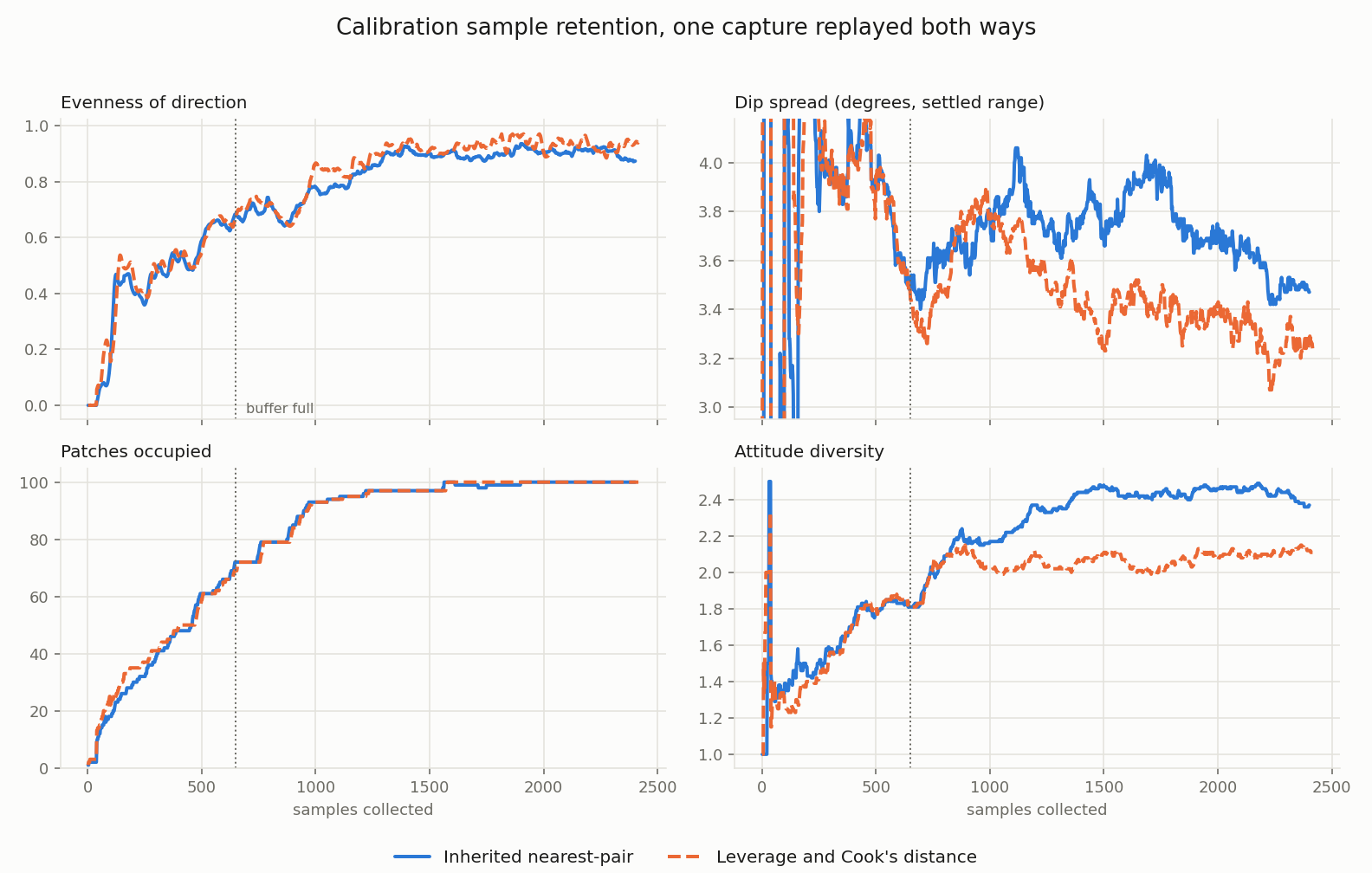
Final tick, and the mean over the last quarter of the run (the final tick alone is noisy enough to mislead):
| Policy | Coverage | Evenness (final / tail) | Attitude (final / tail) | Dip spread (final / tail) | Evictions |
|---|---|---|---|---|---|
| Inherited | 100/100 | 0.873 / 0.906 | 2.37 / 2.44 | 3.47 / 3.61 deg | 1752 |
| Leverage | 100/100 | 0.940 / 0.934 | 2.11 / 2.10 | 3.24 / 3.31 deg | 1766 (all leverage) |
Three things to note.
No sample was ever evicted as an outlier. Both runs report 0 of several
thousand evictions attributed to Cook's distance. At n = 650 with p = 10 the
mean leverage is 0.015, so the textbook D > 1 needs a residual of about 25
sigma: unreachable rather than strict.
Recalibrating that number would have left the real fault in place. Cook's
distance measures influence, which is residual multiplied by leverage -- and
leverage is already deciding what to evict as uninformative. Using it twice
points it in opposite directions: high leverage means keep under the eviction
rule and means suspicious under Cook's, so the samples the policy is trying
hardest to preserve are the ones it accuses. The question worth asking is
narrower, and says nothing about how useful a sample is: is this reading
wrong? That is the studentized residual t = r / (s sqrt(1 - h)), thresholded
from a false-positive budget -- at n = 650, t > 4 is about 0.04 expected
false rejections per run. Replaced in cb669bf1.
The improvement continues long after the buffer fills. Evenness is 0.68 (inherited) and 0.67 (leverage) at sample 650, where the buffer fills, and 0.900 and 0.913 by sample 1500. More than half the climb happens after the buffer is full, which matters for what the user interface tells the operator to do: filling the buffer is not the end of useful collection.
Attitude diversity falls under leverage -- 2.10 against 2.44 -- and keeps falling as samples accumulate. Followed up in experiment 5.
Experiment 3: the accelerometer zero-g offset, fitted offline
Result: 76 to 78 mg, dominated by the z axis, on both captures independently.
A sphere fit on the raw accelerometer samples, two passes, wide gate then a gate on the corrected magnitude:
| Fixture | Samples used | Offset (mg) | Magnitude | Radius | Residual |
|---|---|---|---|---|---|
| 775 | 687 of 775 | (-29.1, +2.0, -72.6) | 78.2 mg | 995.0 mg | 32.4 mg |
| 2425 | 2223 of 2425 | (-31.8, +5.0, -68.7) | 75.9 mg | 993.7 mg | 31.3 mg |
The two captures agree to 2.3 mg, and the fitted radius is within 0.7 percent of one g, so the factory sensitivity constant is already right and only the offset is worth removing. The LIS2DU12 datasheet gives +/- 11 mg typical zero-g offset for the bare part; 76 mg is seven times that, which is consistent with solder and package stress on a board-mounted part rather than with a datasheet violation.
The offset is perpendicular to the board, which is the worst place for it. Projected onto the orientations actually sampled in the 2425 capture it produces a tilt of 3.4 degrees mean, 4.7 degrees worst case. Because the tilt's direction rotates with the tag while its magnitude stays nearly constant, it appears as dip scatter, not as dip bias -- which is why the dip mean was already correct to 0.16 degrees between captures while the spread was 3.5 degrees.
Predicted removal, subtracting in quadrature from the experiment 2 results: 2.53 degrees under the inherited policy, 2.22 under leverage.
Experiment 4: accelerometer calibration wired in
Result: 1.1 degrees of dip spread removed under both policies, matching the offline prediction. The policies' dip-spread gap narrows from 0.31 to 0.15 degrees but does not close.
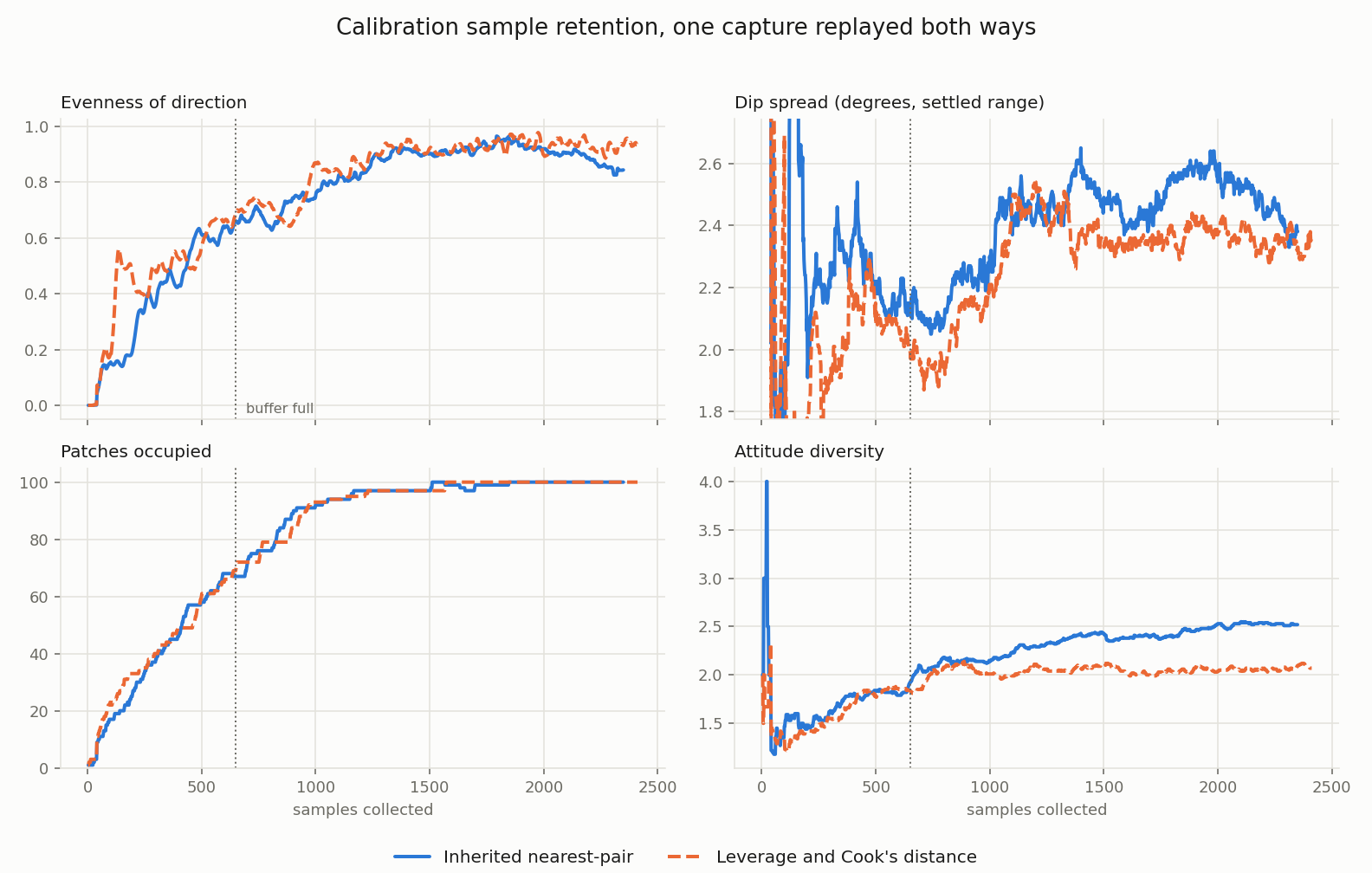
| Policy | Coverage | Evenness (final / tail) | Attitude (final / tail) | Dip spread (final / tail) | Evictions |
|---|---|---|---|---|---|
| Inherited | 100/100 | 0.843 / 0.903 | 2.52 / 2.50 | 2.38 / 2.52 deg | 1699 |
| Leverage | 100/100 | 0.934 / 0.935 | 2.07 / 2.06 | 2.36 / 2.36 deg | 1761 (all leverage) |
Against experiment 2, by tail mean: dip spread 3.61 to 2.52 (inherited) and 3.31 to 2.36 (leverage). Evenness and attitude diversity are unchanged within noise, as they should be -- both are magnetometer-geometry measures and the accelerometer does not enter them.
Two defects in the plotting tool surfaced here, both fixed before the figures above were generated.
The dip panel had a fixed 2.5 to 6.0 degree window, chosen when the steady state was 3.5. The correction moved the whole curve below the floor and emptied the panel. The window is now taken from the data after the buffer fills.
The x axis was wrong for the first 650 samples of every figure drawn before this. It counted quality ticks, assuming one per sample; the tick actually fires every second sample, so the pre-fill half of the axis was compressed by about two and the "buffer full" marker sat at sample 650 while the curve reached its first eviction at 328. The axis is now the gate line's holdings plus the eviction count, which is exact on both sides of the join and puts the first eviction at 651 as it should. Nothing in the comparisons changes -- the error was identical in both runs of each pair -- but the absolute sample numbers read off earlier figures were wrong below 650.
The curve changed shape, not just level. Before the correction dip spread fell monotonically from about 4 degrees. After it, it reaches a minimum just past the buffer-full point -- 2.05 degrees at sample 741 inherited, 1.87 at sample 711 under leverage -- and then climbs to 2.48 and 2.35 beyond sample 2000. That inversion is what should happen once the dominant error is gone: early in a capture the sample cloud is concentrated, so the inclination estimate looks tight by construction, and as coverage spreads over the sphere the spread grows to its honest value. The old 3.5 degree floor was hiding it, and it is a caution against reading an early dip number as a good one.
Experiment 5: why attitude diversity goes the wrong way
Result: not a defect in the retention policy. The leverage criterion is structurally blind to the motion attitude diversity measures, and the metric is being read off the wrong population.
Leverage is computed on the ten-element magnetometer design vector. Rotating the tag about the field axis leaves the field unchanged in body coordinates -- that is what makes it the field axis -- so the design vector is unchanged and the leverage is identical. The policy sees a duplicate and evicts it. That same rotation is the only motion that fills new gravity cells within one magnetometer patch. The two measures are orthogonal by construction, and the policy is correct by its own objective: it is discarding attitude variety that carries no magnetometer information.
The metric's range is also much narrower than it looks. Field and gravity are separated by a fixed angle at any site -- 90 + 63.6 = 153.6 degrees here -- so within one magnetometer patch the gravity direction is confined to a small circle, not the whole sphere. Tracing that circle against the Fibonacci lattice over 400 random field directions:
| Gravity patches | Reachable cells per magnetometer patch |
|---|---|
| 16 (current) | 3.56 (range 2 - 5) |
| 32 | 5.21 |
| 64 | 7.51 |
So the useful range is about 1 to 3.5, not 1 to 16. The observed 2.50 and 2.06 are 70 and 58 percent of achievable -- a far larger gap than the raw numbers suggest, and a number with a meaningful 1.0 if divided by a ceiling computed from the measured dip.
attitudeCells, the unnormalised count, is already computed but not logged.
withGravity, the denominator, is neither logged nor exposed.
Experiment 6: the coupling, measured
Result: confirmed. The two policies converge on offsets 3.05 mg apart, and both sit about 4 mg from the unbiased answer -- 0.23 degrees of tilt, the same order as the dip-spread differences being argued about.
CompassData::fitGravity() iterated the magnetometer buffer gated on
magcal.valid[i], so the accelerometer calibration was fed whatever survived
the magnetometer's retention policy. By the argument in experiment 5 the
samples that policy evicts first are the rotation-about-the-field ones, which
are the most informative for a gravity sphere fit, and a sphere fit's centre
does move under uneven direction coverage.
Logs errlog-acc2-*, at 995ea02b:
| Policy | Offset (mg) | Magnitude | Radius | Readings used |
|---|---|---|---|---|
| Inherited | (-28.99, +6.14, -66.03) | 72.37 mg | 990.8 | 580 |
| Leverage | (-28.56, +3.26, -66.94) | 72.86 mg | 992.5 | 598 |
| Offline, whole capture | (-31.79, +5.02, -68.74) | 75.90 mg | 993.7 | 2223 |
The two policies differ from each other by 3.05 mg and from the whole-capture
fit by 4.05 and 4.10 mg. AccelCalibration on the same capture, holding 256
readings chosen by direction rather than by the magnetometer, lands within
1.6 mg of the whole-capture fit -- so the error here is the coupling, not the
sample count.
residual reads 0.00 on every tick of both logs. GravityFit never assigned
it; see the withdrawn claims below.
Experiment 7: how much of this is run-to-run noise
Result: enough to have invented the dip-spread result. Replaying one capture twice under one policy moves the dip spread by up to 0.13 degrees, which is larger than the policy gap that survived experiment 4.
The replay was not reproducible, for three reasons, all now fixed in
382c879d.
The largest was not in the code at all. The log is saved by clicking Save Log, so a run ends wherever the operator happened to click: 1758 against 1699 evictions under the inherited policy is 2408 samples against 2349, out of 2425 in the capture. Neither run reached the end.
The inherited policy also broke ties with std::rand(), and the quality tick
ran on its own 200 ms timer against the 100 ms sample tick, so which sample a
given line described drifted with scheduler jitter.
Tail means over the last quarter, same capture, same policy, two runs:
| Policy | Metric | Run 1 | Run 2 | Spread |
|---|---|---|---|---|
| Inherited | dip spread | 2.515 | 2.381 | 0.133 |
| Inherited | evenness | 0.903 | 0.903 | 0.000 |
| Inherited | attitude | 2.495 | 2.544 | 0.049 |
| Leverage | dip spread | 2.363 | 2.389 | 0.026 |
| Leverage | evenness | 0.935 | 0.934 | 0.001 |
| Leverage | attitude | 2.061 | 2.107 | 0.046 |
Against the policy gaps measured on the newer pair:
| Metric | Inherited - leverage | Run-to-run spread | Verdict |
|---|---|---|---|
| Dip spread | -0.008 | up to 0.133 | noise |
| Evenness | -0.030 | 0.001 | real, 30 to 1 |
| Attitude | +0.437 | 0.049 | real, 9 to 1 |
So the leverage policy's one measured advantage is direction evenness. Its dip-spread advantage does not survive a second replay, and the sign flips.
Experiment 8: the attitude denominator
Result: the denominator is identical between policies, so the attitude drop is a real loss of cells.
Both runs report 100 patches carrying gravity, so attitudeDiversity
differs only in its numerator: 252 cells against 213, a loss of 39. Against
the 3.56 cells per patch the site geometry allows -- 356 over 100 patches --
that is 71 percent against 60 percent of achievable.
The tool the later experiments were done with
Experiments 10 and 11 were not run through qtcalibrate at all. They were run
with capture_replay, which feeds a committed fixture straight into the
library and prints what the calibration code makes of it, sample by sample.
It is built with the offline checks
(host/libraries/sensoranalysis/test/README.md has the commands) and lives
beside them.
Every question in this investigation turned out to be about a trajectory
rather than an endpoint -- does the offset settle, when does a metric stop
improving, did that change move anything -- and a replay through qtcalibrate
answers those badly. It needs the Qt build, a window and a run in real time,
and it reports through a log at one line per two samples. That is how the
13 mg wander in experiment 10 was found: by watching a log scroll past.
The tool answers the same questions in a second, which is what made
experiment 11 worth doing at all. Four accelerometer models over 2425 samples,
each scored on inclination spread, is one command; through qtcalibrate it
would have been four builds and four sweeps, and the question would have
stayed open.
It is validated against qtcalibrate rather than trusted: on the 2425-sample
fixture it reports an inclination spread of 2.470 degrees where qtcalibrate
logs 2.58 for the same capture, the difference being that qtcalibrate
measures over its retained 650 samples and this measures over all of them.
Three traps found while building it, each of which produced a plausible wrong number rather than an error, and each of which applies to anything else reading a capture:
- a capture stores its constants as
offsetandmapping, not under the embeddedv0/a00namesCompassCalibration::fromMagnetometerJson()reads, so reading it that way yields an identity calibration silently; deriveCalibratedSample()wants magnetometer vectors that are already corrected, which is howqtcalibratecalls it. Fed raw ones it reported an inclination spread of 48 degrees.deriveSample()is the call that applies the constants itself;- inclination has to be gated on acceleration magnitude exactly as
MagQualitygates it. A reading taken mid-swing has no meaningful inclination, and ungated the spread describes the sweep rather than the calibration.
A fourth was in the throwaway harness that preceded it rather than in the
tool: it paired each accelerometer reading with the previous sample's
magnetometer, because mag follows accel in the file and the search ran
backwards. That alone turned 2.47 degrees into 5.34, and it is the kind of
discrepancy that sends you looking for a fault in the library.
Experiment 10: the split, measured
Result: the offset settles to 1.33 mg of movement where it used to wander 13.35, and the retention policy can no longer reach it at all.
capture_replay on the 2425-sample fixture, with the accelerometer
calibrating from its own population:
| Offset | Settling (second half) | Readings used | |
|---|---|---|---|
| Coupled to the magnetometer buffer, inherited policy | 72.37 mg | not measured | 580 |
| Coupled, leverage policy | 72.86 mg | not measured | 598 |
| Own population, per-patch ring (first attempt) | 77.54 mg | 13.35 mg | 256 |
Own population, accumulated (2a2ebc18) |
74.55 mg | 1.33 mg | 2224 |
The two policies no longer need comparing on this. The accelerometer never sees the magnetometer buffer, so the retention policy cannot change its offset by construction, and the 3.05 mg the two policies used to disagree by is gone rather than reduced.
Inclination on the same capture: 3.612 degrees uncorrected, 2.470 with the offset removed.
The trajectory shows two things a final number does not. The fit goes valid before sample 200, at 19 of 32 patches, reading 93 mg against the 74.5 it settles at -- an error of 19 mg, which is still far better than the 74.5 mg of applying nothing, so the preconditions are doing their job rather than being too loose. And it is within 3 mg of final by sample 1000 and within 1 mg by 1200, which is about half the sweep: useful for telling an operator when the accelerometer has had enough, separately from the magnetometer.
Experiment 11: an ellipsoid for the accelerometer
Result: the anisotropy is real and worth 0.04 degrees. Not worth having.
Open question 3 asked for this to be re-tested on an unbiased population, since the earlier rejection was measured on the magnetometer-pruned set. Judged on inclination spread rather than fit residual, because residual always improves with more parameters:
| Accelerometer model | Inclination spread | p95 |
|---|---|---|
| None | 3.587 deg | 6.81 |
| 4-parameter sphere (offset) | 2.458 deg | 5.74 |
| 7-parameter (offset and per-axis scales) | 2.419 deg | 5.70 |
| 10-parameter full ellipsoid | 2.413 deg | 5.68 |
The anisotropy is genuine: relative axis scales 1.00926, 1.00048, 0.99026, and the 7- and 10-parameter fits agree on them to five decimals, which says the cross terms carry nothing. But a scale error tilts the measured gravity only between the axes it differs across -- maximally at 45 degrees, not at all on axis -- so over a sweep most of it averages away and some is absorbed into the median. 0.04 degrees of a 2.4 degree spread does not pay for three to six more parameters, a matrix square root, and the tighter coverage a 7-parameter fit needs to stay conditioned.
What this rules out matters more than what it measured. The 2.4 degrees that remain are not accelerometer offset and not accelerometer scale. That points at the magnetometer side, or at the two sensors not being read simultaneously while the tag turns -- which the rotation-rate gate below would test.
Experiment 12: rotation rate
Result: turning faster does measurably widen the inclination spread, and gating on it is still not worth doing. The remaining 2.4 degrees is not rotation either.
No target has a gyroscope, so the rate is estimated from the angle between consecutive calibrated magnetometer directions over the 100 ms sample interval. On the 2425-sample fixture:
| Rotation rate | Samples | Inclination spread |
|---|---|---|
| below 30 deg/s | 568 | 2.415 deg |
| 30 to 60 | 1058 | 2.250 deg |
| 60 to 90 | 485 | 2.668 deg |
| 90 to 120 | 148 | 3.053 deg |
| over 120 | 54 | 3.658 deg |
The rise above 60 deg/s is monotonic and large -- a factor of 1.6 from the 30-60 band to the fastest one -- which is what two sensors read at slightly different instants should look like while the tag turns.
But a band's spread is not what a gate is worth, because the pooled statistic is set by the bulk:
| Gate | Kept | Discarded | Pooled spread |
|---|---|---|---|
| 30 deg/s | 568 | 1745 | 2.415 deg |
| 60 deg/s | 1626 | 687 | 2.330 deg |
| 90 deg/s | 2111 | 202 | 2.390 deg |
| 120 deg/s | 2259 | 54 | 2.437 deg |
| none | 2313 | 0 | 2.469 deg |
The best gate, at 60 deg/s, buys 0.139 degrees for 30 percent of the samples, and the run-to-run wobble measured in experiment 7 is 0.13. The gain sits at the floor of what can be distinguished. Gating at 30 is worse than not gating above 30 at all, which says the slowest band is limited by something else.
So the gate is declined and the guidance is kept. The finding belongs in front of the operator, not in the metric: the data puts the knee at about 60 deg/s rather than the 90 estimated earlier, so a rotation indicator should read green below 60, yellow to 120 and red above. That costs no samples and addresses the cause.
And it closes off the third candidate. Even the 30-60 band sits at 2.25 degrees, so the floor is about 2.25 whatever the tag is doing. Non-simultaneous sampling accounts for roughly 0.2 degrees across the bulk of a sweep, not for the 2.4 that remain. With the accelerometer ruled out by experiment 11 and the room not measurable without a clean site, what is left is the magnetometer itself -- its own noise, and distortion that moves as the tag moves.
Claims made and withdrawn
Recorded because each cost time and each would otherwise look settled.
Two bugs claimed in CompassProcessor::computeOrientation. Withdrawn. The
three lines compose to exactly one axis permutation and are correct. The
synthetic test that found the "bugs" fed an already-aligned magnetometer and
accelerometer pair, so the routine's board correction un-aligned it. A second
board disproved the claim directly.
The evenness sag blamed on the discard policy. Withdrawn. On the short capture evenness peaks at 0.775 by sample 194 and troughs at 0.506 by sample 566, and the first eviction of the run is at sample 652. The whole sag happens before any sample is discarded, so no discard policy caused it.
The dip-spread floor blamed on the room. Withdrawn. It was the 76 mg accelerometer offset, as experiment 4 showed by removing 1.1 degrees of it. The room is still responsible for the 12 percent field deficit and the shallow inclination.
Attitude diversity's fall blamed on the per-patch-mean denominator. Withdrawn, and now measured: experiment 8 shows the denominator is exactly 100 in both runs, so the fall is entirely in the numerator. The denominator is still a poor choice -- it rewards concentration -- but it is not what happened here.
The leverage policy called better on dip spread. Withdrawn. Experiment 7 shows a second replay of the same capture under the same policy moves the dip spread by more than the gap did, and on the newer pair the gap is 0.008 degrees with the sign reversed. Direction evenness is the only advantage that survives a repeat. The larger gap measured before the accelerometer correction -- 0.31 degrees, against 0.13 of noise -- may still be real, but it was measured once and should not be quoted as settled either.
GravityFit reported a residual. It never did: Result::residual was
left at zero because the accumulator held the sum of |p|^2 where the
algebraic residual needs the sum of its square. Every fit since f2923035
reported 0.00, including both errlog-acc2-* logs. Fixed in dae352c7; the
reference capture reports 30.7 mg, which is model error rather than noise.
Open questions
- Find where the remaining 2.4 degrees of inclination spread lives. Experiment 11 rules out the accelerometer and experiment 12 rules out rotation. The room is not worth chasing -- it cannot be measured without a clean site, and the premise of the environment section is that field use will not have one. That leaves the magnetometer: its own noise, and distortion that moves as the tag moves. The first is separable -- a tag held still has a measurable sample-to-sample scatter, and a capture with a still period in it would settle how much of the 2.25 degree floor is simply noise.
- Show rotation rate to the operator -- green below 60 deg/s, yellow to 120, red above -- which experiment 12 supports and which costs no samples. The rate itself has to be accumulated from the sample stream, the same place the attitude metric belongs.
- Rebuild the attitude metric on the sample stream, normalised by the ceiling the site geometry allows. Experiment 8 showed it falls for a real reason, experiment 5 that the fall is not a fault, and the ratio's range is 1 to 3.5 rather than 1 to 16 -- so the number on screen misleads in three separate ways while the calibration underneath is fine.
- The numbers in experiments 2, 4, 6 and 8 were measured on runs that ended wherever the operator clicked, so read them as indicative rather than settled. They are not being repeated: every effect large enough to matter is far clear of that wobble -- the accelerometer correction at 1.1 degrees against 0.13, direction evenness at 30 to 1, attitude diversity at 9 to 1 -- and the one claim that was not survived only as experiment 7's retraction.